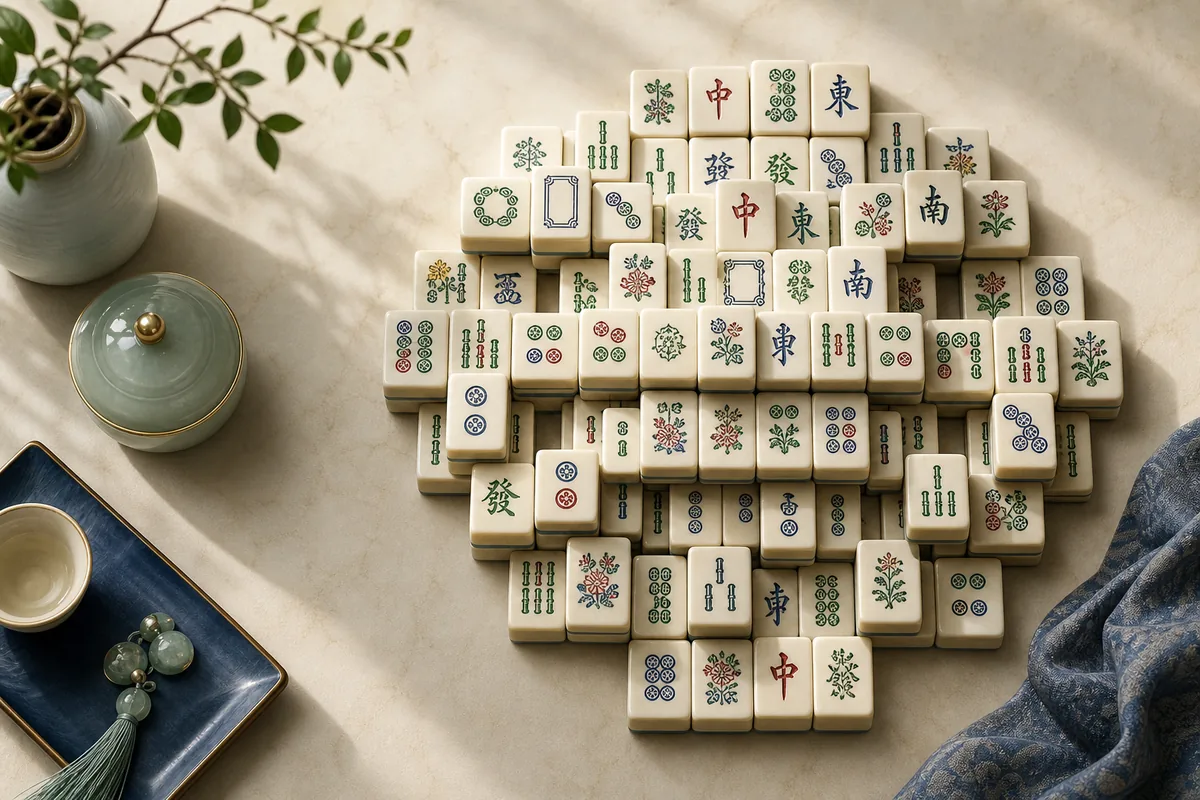
Read the board before chasing a match
Mahjong Solitaire is a one-player matching puzzle built from the visual language of traditional mahjong tiles. The objective is simple: remove pairs until the layout is empty. The important constraint is structural. A tile normally needs no tile covering it and at least one long side open. Two identical pictures may look tempting, but the pair is irrelevant until both pieces are free.
A strong opening begins with a short scan rather than the first available click. Look at the highest stacks, the far ends of long rows, and any tile that blocks several others. Removing a pair from those pressure points changes the board more than clearing two isolated pieces. This is the central habit behind reliable tile matching: judge a move by what it exposes, not only by what it removes.
Matching rules that prevent common mistakes
Most suits require exact pictures to match: Bamboo 3 pairs with Bamboo 3, not another Bamboo value. Winds and Dragons also match identically. Flowers form one special group and Seasons another; in common solitaire rules, any Flower may match another Flower, and any Season may match another Season. A Flower and a Season do not form a pair.
When several matching pairs are available, preserve flexibility. If one copy sits safely on an outside edge while another seals a tall stack, use the blocked area as your guide. Avoid consuming both exposed copies when a third matching tile is still buried beneath one of them. That small pause protects future moves and reduces avoidable dead ends.
A practical rhythm for relaxed play
Work in cycles: scan the whole board, identify two or three candidate pairs, then choose the move that reveals the most useful information. Recheck after every removal because accessibility can change immediately. On a phone, zoom or a large-tile view can matter more than speed; on desktop, full-screen space makes symbols easier to compare.
This site separates rules, layouts, accessibility choices, and deeper strategy into focused guides so a player can solve the exact question in front of them. The PLAY control is already part of the interface, but its destination is not live yet. Until it is connected, the articles remain a truthful reference rather than pretending an embedded game exists.
Quick answers
Questions players ask
Is this traditional four-player mahjong?
No. The guides focus on Mahjong Solitaire, a single-player matching puzzle. Traditional mahjong uses hands, draws, discards, calls, and regional scoring systems.
Do I need to read Chinese characters?
No. You only need to recognise identical tile faces and the two special bonus groups. Familiarity grows naturally after a few boards.