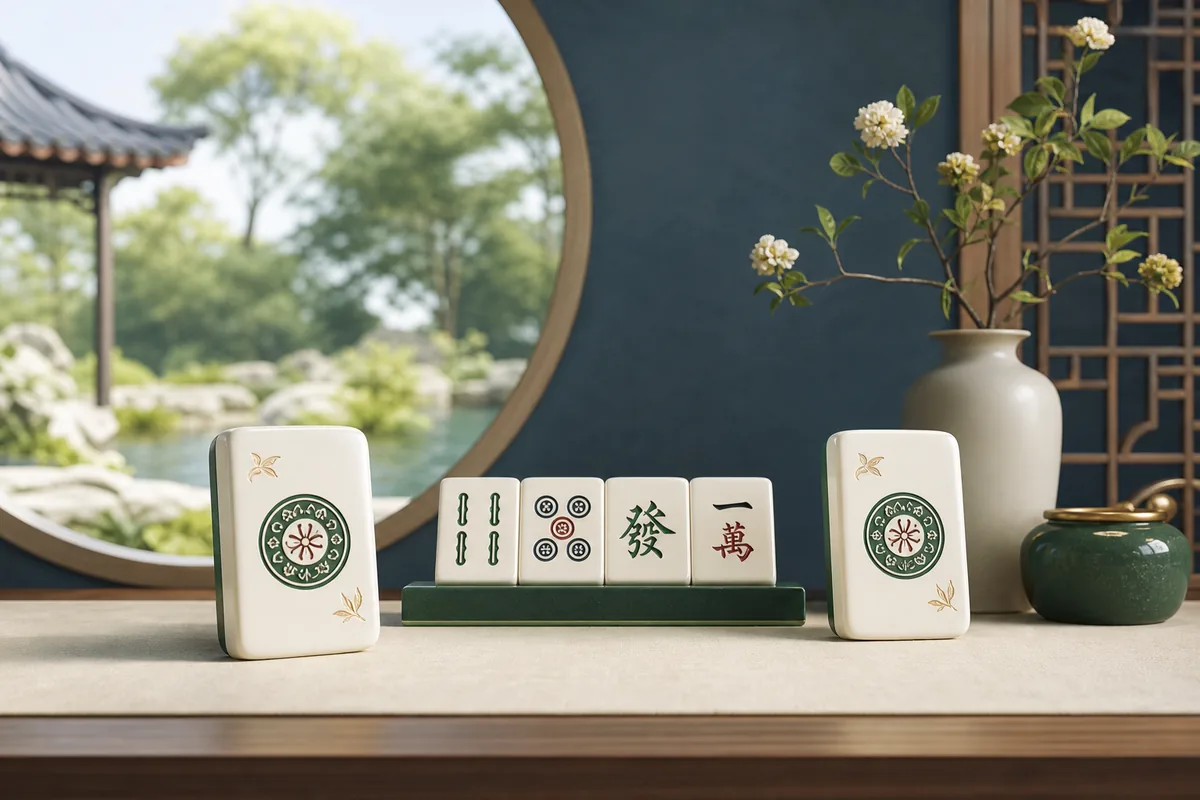
Begin with the free-tile test
A selectable tile needs a clear top and at least one open long side. Practice identifying free pieces before looking for pictures that match. This order prevents the most common beginner error: finding an identical pair and assuming both pieces can be removed.
Start on the outer contour and highest layer. A compact tutorial layout makes overlaps obvious and lets the player predict which piece will open next. Correct feedback should explain a blocked selection rather than merely ignoring it.
Learn the tile groups gradually
Circles, Bamboo, and Characters match by identical suit and value. Winds and Dragons also require identical faces. Flowers can pair with other Flowers even when their illustrations differ, and Seasons can pair with Seasons. Keep those two bonus groups separate.
There is no need to memorise every Chinese character before playing. Compare the complete design, including colour, number, and border details. Over several boards, recurring Winds and Dragons become familiar without a vocabulary test.
Use a three-part move routine
First find all legal matches you can see. Second, compare what each pair would uncover. Third, choose the pair that opens a high stack or long row while preserving other duplicate faces. Rescan after the removal because accessibility has changed.
Hints are useful after a genuine attempt, and undo can demonstrate why one branch failed. Avoid rapid random clicking; it teaches neither symbol recognition nor planning. A first win matters less than understanding why the board remained open.
For the first few sessions, use a layout with fewer layers and keep Flower and Season group markers visible. Once the free-tile check feels automatic, move to a full Turtle board and add complexity without adding a timer.
Mistakes are useful when they can be explained. If the board blocks, identify one pair that should have been preserved and replay from that point. This connects the result to a decision instead of making the deal feel arbitrary.
Use a beginner-friendly board checklist
For early practice, choose a small or low layout, an untimed mode, clear free-tile highlighting, and unlimited undo. Confirm that the rules explain Flowers and Seasons before play. These settings reduce avoidable confusion while preserving the central challenge of choosing pairs in a useful order.
After completing a board, remove one aid at a time rather than increasing every difficulty setting together. Turn off free-tile highlighting before limiting undo, or move to a taller layout while keeping the timer disabled. A single change makes it clear which skill needs more practice.
Applied analysis
A sensible learning progression
Begin with a compact layout that has shallow overlap and visible group markers. Once you can predict free tiles without clicking them, move to a wider board with four copies of ordinary faces. Add a tall central stack next, and introduce a timer only after deliberate scanning feels natural. Difficulty should come from one new demand at a time. A board that simultaneously uses tiny art, unfamiliar symbols, deep layers, and time pressure does not teach faster; it hides which skill caused the mistake and encourages random selection.
Quick answers
Questions players ask
Do beginners need a full 144-tile board?
No. A smaller teaching layout can demonstrate the authentic rules before introducing the full classic structure.
Must I know traditional mahjong first?
No. Mahjong Solitaire is a separate single-player puzzle, so traditional hands and scoring are not required.