What “classic” normally includes
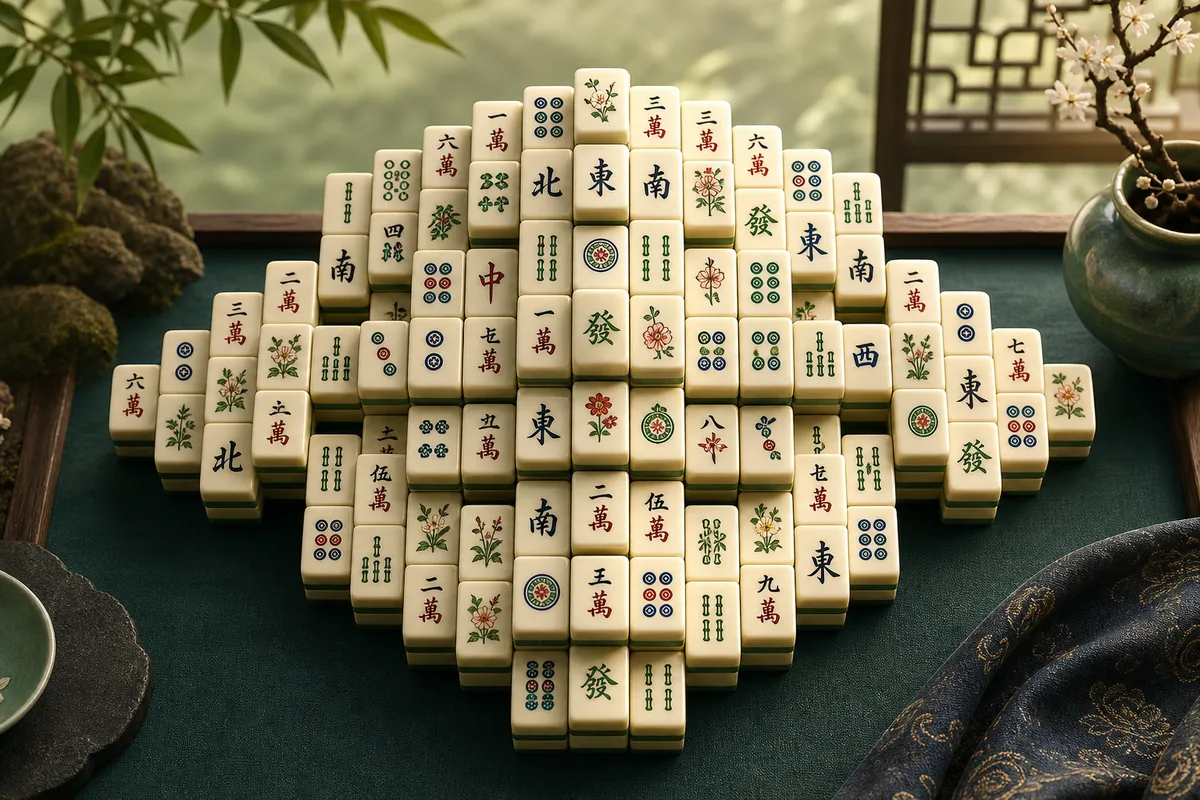
The recognised solitaire format uses 144 tiles: numbered Circle, Bamboo, and Character suits; Winds and Dragons; plus Flowers and Seasons. Four copies of ordinary faces create two possible pairs. Bonus tiles appear once each, so Flowers match within their group and Seasons match within theirs. Implementations vary, but these conventions make the board immediately legible to experienced players.
The Turtle layout became the visual shorthand for the game because it combines a broad base, raised body, narrow head and tail, side pieces, and a high central tile. Those overhangs create different types of locks. An end tile may release a whole row, while the top tile provides an early match but does little for the base by itself.
A classic opening plan
First inspect the topmost tile and the far left and right edges. Then note duplicated faces that are currently exposed. If all available copies of one symbol sit in easy positions, delay them unless they release something valuable. Scarce exposed symbols deserve closer attention because using the wrong pair can strand the other copies.
Aim to lower the central stack while shortening the longest rows. A board that becomes flat but remains very wide can still lock; a narrow board with one tall tower has the opposite problem. Alternating between height and width preserves multiple routes into the layout and makes later choices easier to evaluate.
Authentic does not mean inflexible
Digital versions may add hints, undo, timing, or a reshuffle. Those controls change the level of assistance, not the free-tile rule. A no-time-limit mode is ideal for studying the board, while a timer can add replay value once symbol recognition becomes automatic. Neither is inherently more authentic.
What matters is clear disclosure. A site should distinguish Mahjong Solitaire from four-player Chinese, American, Hong Kong, or Japanese Riichi rules. They share tile imagery but ask for completely different skills. Here, “classic” describes the established single-player layout and matching conventions.
Check the layout before assuming classic rules
The word “classic” does not guarantee an identical deal on every site. Some boards use the full 144-tile Turtle, while others remove bonus tiles, use fewer layers, or allow only exact Flower and Season matches. Before the opening move, check the tile count, the help panel, and whether the deal is advertised as solvable. These details affect strategy more than decorative differences in tile art.
If the layout is unfamiliar, identify its longest row, tallest stack, and any detached end pieces. Those three features reveal where access is most fragile. You can then apply the classic principle—reduce width and height together—even when the board is not a traditional Turtle.
Applied analysis
A useful endgame audit
When roughly thirty tiles remain, stop and count faces before continuing. Late positions contain fewer alternative partners, so a careless pair is harder to repair. Look especially for two identical tiles occupying the same vertical chain or trapped inside the same row. Then identify which exposed copies can release them. This audit takes less than a minute and often reveals that an ordinary edge tile has become strategically essential. Classic play rewards this change of pace: broad opening analysis becomes precise duplicate management near the finish.
Quick answers
Questions players ask
Does classic mean four-player mahjong?
Not on this page. It describes the established single-player solitaire format; traditional mahjong is a separate family of competitive games.
How many tiles are on a classic board?
A full classic solitaire board normally contains 144 tiles, although compact digital layouts may use fewer.