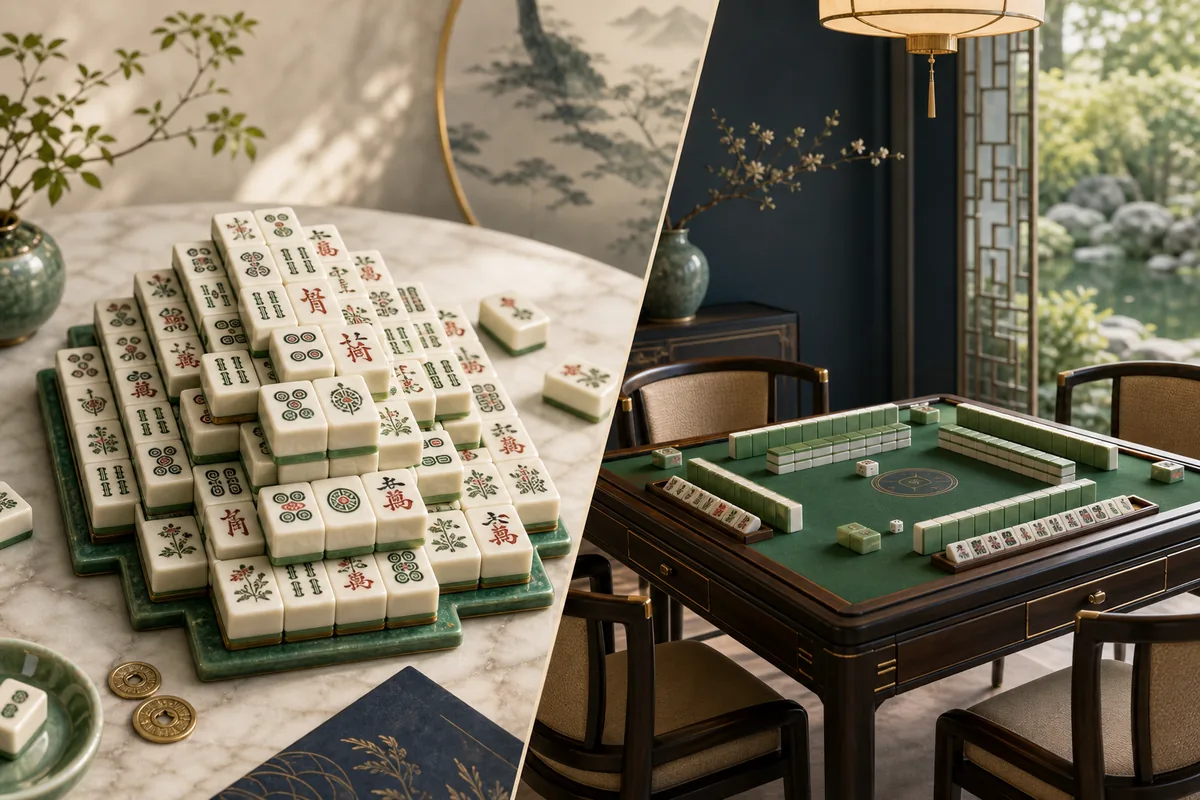
Different objectives and turn structures
In traditional mahjong, players draw and discard tiles to assemble a legal winning hand under a regional ruleset. They may call certain discards, manage concealed information, and calculate score. American, Chinese, Hong Kong, and Japanese Riichi forms differ substantially, so “the rules of mahjong” always need regional context.
Solitaire has no hand, wall, opponents, or discard decisions. All tile positions are visible. You remove matching free pairs from a layered layout until it is empty or no legal pair remains. The governing question is spatial access rather than hand composition.
How the same tiles behave differently
Both games may use Circles, Bamboo, Characters, Winds, Dragons, Flowers, and Seasons. In Solitaire, ordinary faces match identically and bonus groups form flexible pairs. In traditional play, suits form sequences and triplets, honour tiles form sets, and bonus tiles can affect scoring or replacement draws depending on the rules.
Recognising tile faces can transfer between the games, but strategic knowledge does not transfer directly. Knowing which Solitaire pair opens a row does not teach Riichi defence, and understanding a traditional winning hand does not solve a stacked Turtle layout.
Why online naming becomes confusing
Many browser puzzles shorten their name to “Mahjong” because the tile imagery is instantly recognisable. A responsible page clarifies “Mahjong Solitaire” near the beginning so visitors looking for multiplayer rules are not misled. Search labels can remain familiar without erasing the distinction.
Choose the solitaire puzzle for a self-contained matching session. Choose traditional online mahjong when you want opponents, regional scoring, concealed hands, and longer rule study. Neither is a lesser version of the other; they serve different play experiences.
Before following a play link, check the description for words such as single-player, matching pairs, Turtle layout, Riichi, American card, or Hong Kong scoring. Those labels reveal far more about the intended game than tile artwork alone.
Recognise which game a page is offering
A layered board with every tile visible, pair removal, hints, and undo indicates Mahjong Solitaire. A table with concealed hands, a wall of tiles, draws and discards, named calls, and several seats indicates traditional mahjong. The number of players and the objective are more reliable clues than a page title that simply says “mahjong.”
Before joining a multiplayer table, check the ruleset—such as Riichi, Hong Kong, Chinese Official, or American—because scoring and legal calls vary substantially. Solitaire strategy about free edges and covered tiles does not transfer to those games, although familiarity with the tile faces can still help recognition.
Applied analysis
Use the vocabulary to choose correctly
Descriptions such as matching pairs, free sides, layered layout, Turtle, and shuffle point to the solitaire puzzle. Terms such as draw, discard, meld, chow, pung, riichi, Charleston, or scoring card point to traditional competitive variants. “Single-player” alone is not conclusive because some traditional games offer computer opponents. Reading two or three rule terms before following a link avoids a common mismatch: arriving at a spatial puzzle when you wanted a four-player table, or opening a complex regional ruleset when you expected relaxed tile matching.
Quick answers
Questions players ask
Is Mahjong Solitaire an ancient Chinese game?
No. It is a modern single-player puzzle using mahjong tile imagery, distinct from the older competitive game.
Do both games use 144 tiles?
They can use similar full sets, but regional traditional games and digital solitaire layouts may include different counts.