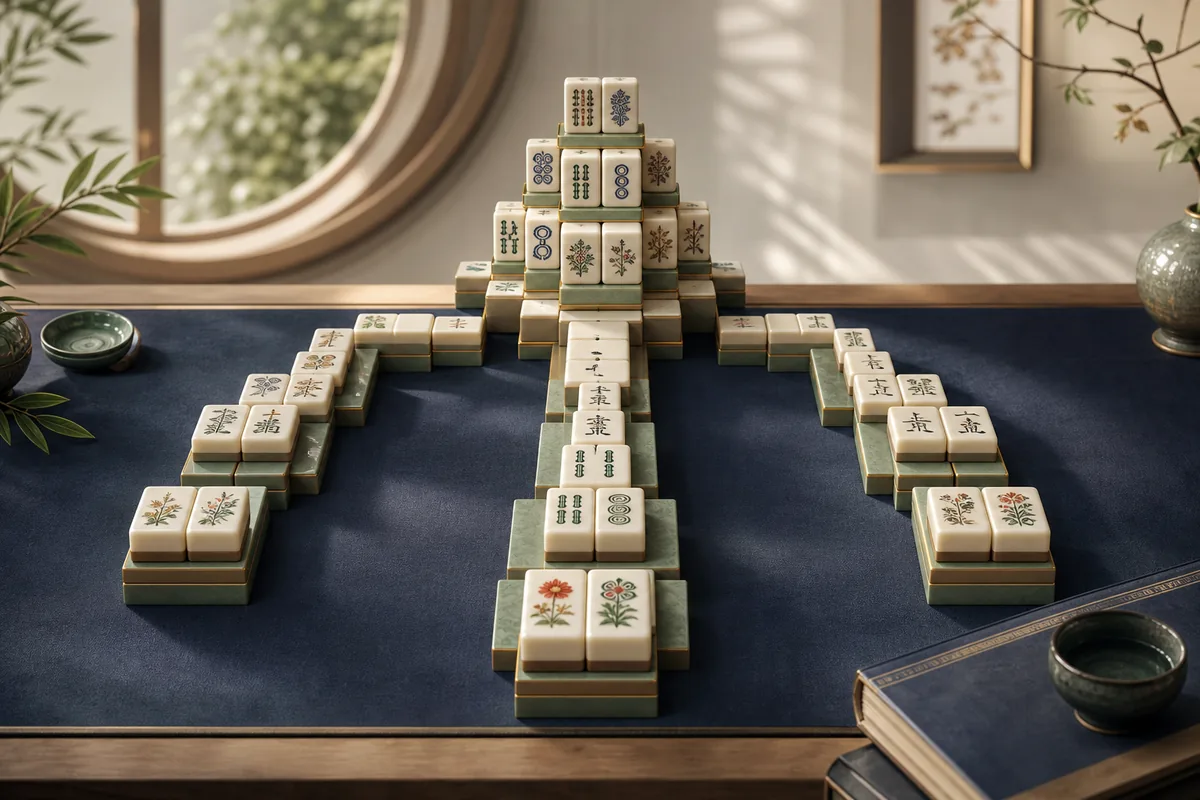
Measure what a pair releases
Pairs have different structural value. Removing two isolated outside tiles may expose nothing; removing one top tile and one row-end tile can open several positions. Before selecting, count the immediate releases and consider whether those new faces are likely to match anything already available.
Reduce height and width together. Focusing only on a central tower can leave the base sealed, while clearing only side rows can preserve a cap over many tiles. Alternating pressure points maintains several entrances into the layout.
Manage four copies as a small network
Ordinary faces usually appear four times. Think of the possible pairings before consuming two copies. If A covers B and the same relationship exists elsewhere, pairing both A tiles together can strand the B tiles. Use outside copies to release stacked copies in an order that keeps at least one partner available.
When three copies are free and the fourth is buried, the choice is not automatically obvious. Preserve the exposed copy that sits in a flexible position and remove the one that unlocks more structure. Re-evaluate after each move rather than following a memorised rule blindly.
Find the real cause of a dead end
The last move before a block is often only the final symptom. Trace the inaccessible pairs backward: which face needed to open, what covered it, and which earlier pair could have removed that cover? Undo to the first meaningful fork, not one step at a time without a hypothesis.
Hints solve a recognition problem, not a planning problem. Use them to confirm that a legal move exists, then decide whether that move improves the board. With practice, the useful question changes from “what can I match?” to “which match leaves the healthiest position?”
One practical exercise is to list the available pairs before moving and rank them by tiles released. The ranking may change when duplicate management is considered, which is precisely why deliberate comparison produces stronger decisions than reflex.
Look ahead one pair, not ten moves
Useful lookahead does not require solving the whole board mentally. For each promising pair, identify the tiles it exposes and ask whether either new face has an available partner. A move that reveals two immediately usable faces creates momentum; a move that exposes two blocked or partnerless faces may only make the board look more open.
Use this two-move horizon when several pairs have similar structural value. It is short enough to calculate accurately and long enough to avoid many traps. Recalculate after the first removal rather than committing to a fixed sequence, because newly exposed information can change the best continuation.
Applied analysis
Score candidate moves before choosing
For a difficult position, give each available pair a quick informal score. Add value for every tile it exposes, for reducing the highest stack, and for opening an end of a long row. Subtract value if it consumes the last flexible partner for a buried copy or leaves identical tiles in the same dependency chain. The numbers need not be exact; the purpose is comparison. This discipline reveals why a move that uncovers two tiles can still be weaker than one that uncovers only one but preserves three future pairings.
Quick answers
Questions players ask
Should I clear the top first?
High tiles often have strong value, but balance them with row ends so the board opens vertically and horizontally.
Is every legal move safe?
No. A move can be legal now and still consume partners needed to release a later stack.