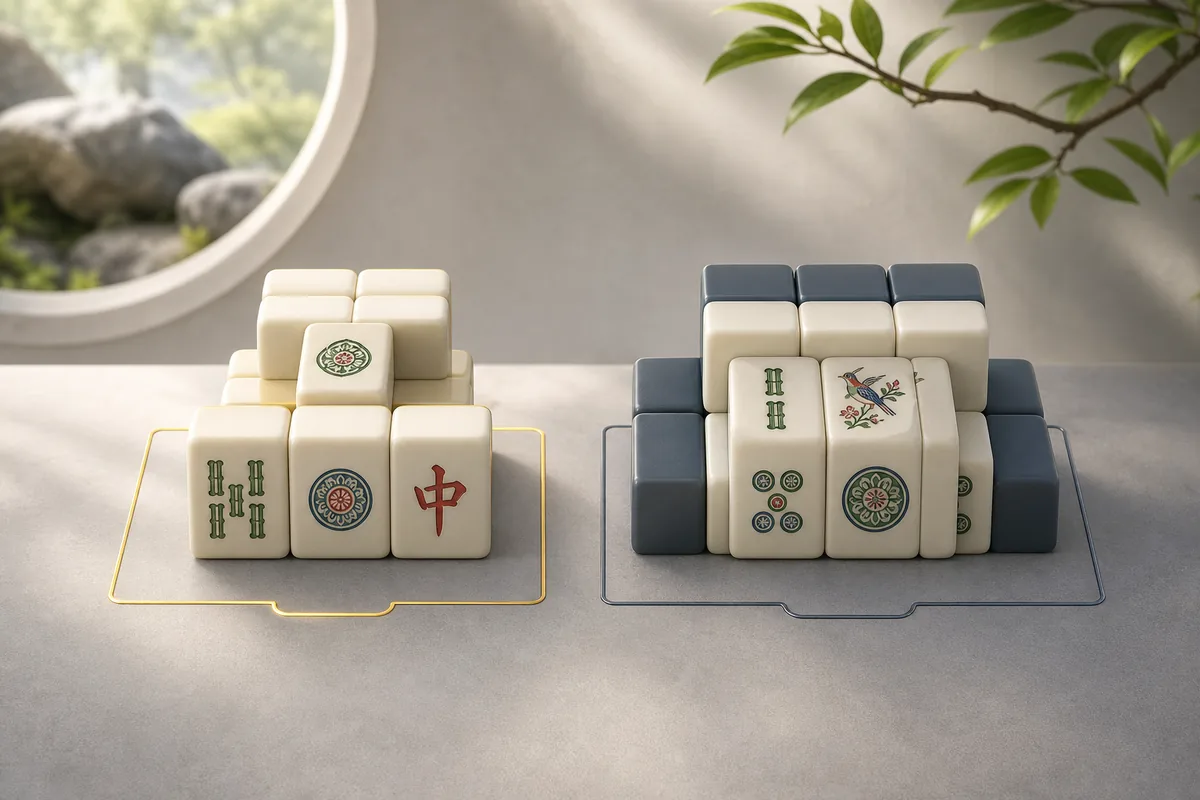
Objective and free-tile condition
The objective is to remove the entire layout in pairs. A tile is free only when no tile overlaps its top and either the left or right long edge is clear. Both sides do not need to be open. A gap at the short top or bottom edge does not qualify, and a partly covered face remains unavailable even if one side is exposed.
Layouts can contain 144 tiles or a smaller even number. The shape does not change the accessibility test. Digital interfaces may shade blocked pieces, but the legal state should be determined by position rather than the artwork or a player’s ability to click rapidly.
Exact matches and bonus groups
Numbered suits, Winds, and Dragons match identical faces. Bamboo 5 does not match Bamboo 6, and an East Wind does not match a South Wind. In the widely used solitaire convention, any Flower matches any other Flower and any Season matches any other Season. Flowers and Seasons are separate groups and cannot cross-match.
Some themed games replace traditional art while preserving identity groups. The interface should make equivalence clear. If a variant changes bonus matching or uses fewer copies, its rules need to say so before the board begins.
Winning, losing, and assistance
The board is won when no tiles remain. It is blocked when tiles remain but no free matching pair exists. A blocked state is not always proof that the initial deal was impossible; an earlier legal choice may have closed the only solution path.
Undo reverses a move and leaves the original puzzle intact. A hint identifies a currently legal pair but does not guarantee that the pair belongs to a full solution. Shuffle redistributes remaining faces and therefore changes the position. Timers, scores, and penalties are optional interface rules rather than part of the core matching system.
House variations should be visible before play. If a board treats every bonus tile as interchangeable, permits covered matches, or changes the side-access test, it departs from the convention described here and needs its own explanation.
Confirm rule variations before the first move
Most implementations share the free-side and uncovered-tile rule, but assistance and bonus matching can differ. Check whether Flowers match any Flower, Seasons match any Season, the deal is guaranteed solvable, and shuffle counts as a loss or a continuation. The game should state these variations rather than leaving players to discover them after a disputed move.
Some interfaces also highlight every selectable tile or prevent clicks on blocked pieces. These are presentation aids, not changes to the underlying rule. A legal pair still requires two free matching tiles even when the software performs part of the check for you.
Applied analysis
Edge cases worth checking
A tile can be free with its left side open even when its right side touches a neighbour; both sides are not required. A small corner overlap from a higher layer still blocks the top, even if most of the face is visible. Two different Flowers may pair, but a Flower and Season may not under the common convention. Finally, a legal pair is not automatically a winning move. These four cases explain most apparent disagreements between a player and the interface. If a game behaves differently, its published variant rules should identify the exception clearly.
Quick answers
Questions players ask
Can two covered tiles match?
Their pictures may correspond, but they cannot be removed until both tiles satisfy the free-tile condition.
Does a hint always show the best pair?
Not necessarily. It usually shows a legal pair, not a move proven to preserve a complete solution.