Why the pictures do not need to match exactly
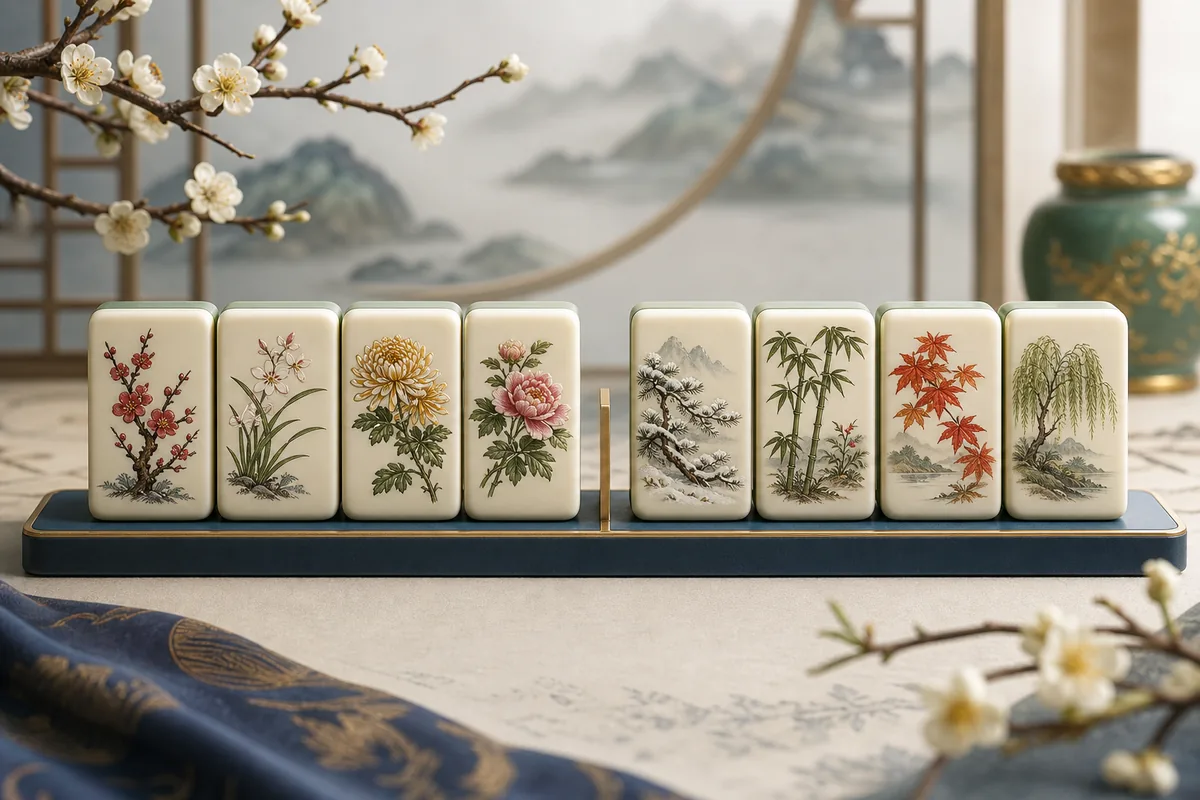
A traditional full set contains four Flower tiles and four Season tiles, each with a distinct illustration or character. Because each individual appears once, exact-picture pairs would be impossible. Solitaire therefore treats the four Flowers as equivalent for matching and the four Seasons as a second equivalence group.
Artwork varies widely between sets. Flowers may show blossoms or numbered labels; Seasons may use landscapes or characters. A digital design should identify the group through a consistent marker rather than expecting every player to recognise the illustration.
Keep the groups separate
Any Flower plus any Flower is normally legal. Any Season plus any Season is normally legal. A Flower plus a Season is not. This distinction is easy to miss when both categories use colourful botanical imagery, so examine the border, corner mark, or group label supplied by the tile set.
The rule belongs to Mahjong Solitaire and should not be confused with the role of bonus tiles in traditional regional games. Competitive rules differ in how Flowers and Seasons affect a hand or score; the single-player puzzle uses them primarily to complete removable pairs.
Use their flexibility carefully
Bonus groups provide more pairing options than a normal face, which makes them useful for releasing difficult positions. If three Flowers are exposed, compare what each possible pair uncovers. Preserve the most accessible Flower when another copy is still buried so it can act as a future partner.
Do not clear bonus tiles automatically just because they are legal. Their strategic value still depends on position. A Flower on top of a central stack may deserve priority over one at an empty edge, while a Season sealing a long row can connect two otherwise separate areas of the board.
If the artwork is unfamiliar, locate all eight bonus pieces during the opening scan and learn the set’s corner marks. That small investment prevents a colourful Season from being mistaken for a Flower when the board becomes crowded.
Identify bonus tiles when the artwork is unfamiliar
Themes may replace traditional plants and seasonal scenes with animals, landscapes, or abstract icons. Bonus tiles are often the only faces that appear once each, and many sets mark them with small numbers or a shared border. Open the tile legend when available instead of relying on the picture alone.
If the interface rejects a plausible pair, do not assume the selection failed. The two tiles may belong to different bonus groups, or that version may require exact matching. Check the help text and then test another pair; repeated random clicks make it harder to learn the set’s actual convention.
Applied analysis
Recognising unfamiliar bonus art
When a tile set uses unfamiliar paintings, look for consistent secondary cues: a number in one corner, a shared border colour, a small Flower or Season mark, or four images arranged as a deliberate series. Identify all eight bonus pieces during the opening scan instead of waiting until only one legal match remains. If the interface offers a legend, compare it before play. Strong artwork can be decorative without being ambiguous; players should never have to guess whether two botanical scenes belong to the same group.
Quick answers
Questions players ask
Can a Flower match a Season?
No. Flowers match within the Flower group and Seasons within the Season group.
Do all tile sets use the same artwork?
No. Images and labels vary, so good digital sets provide a consistent group marker.