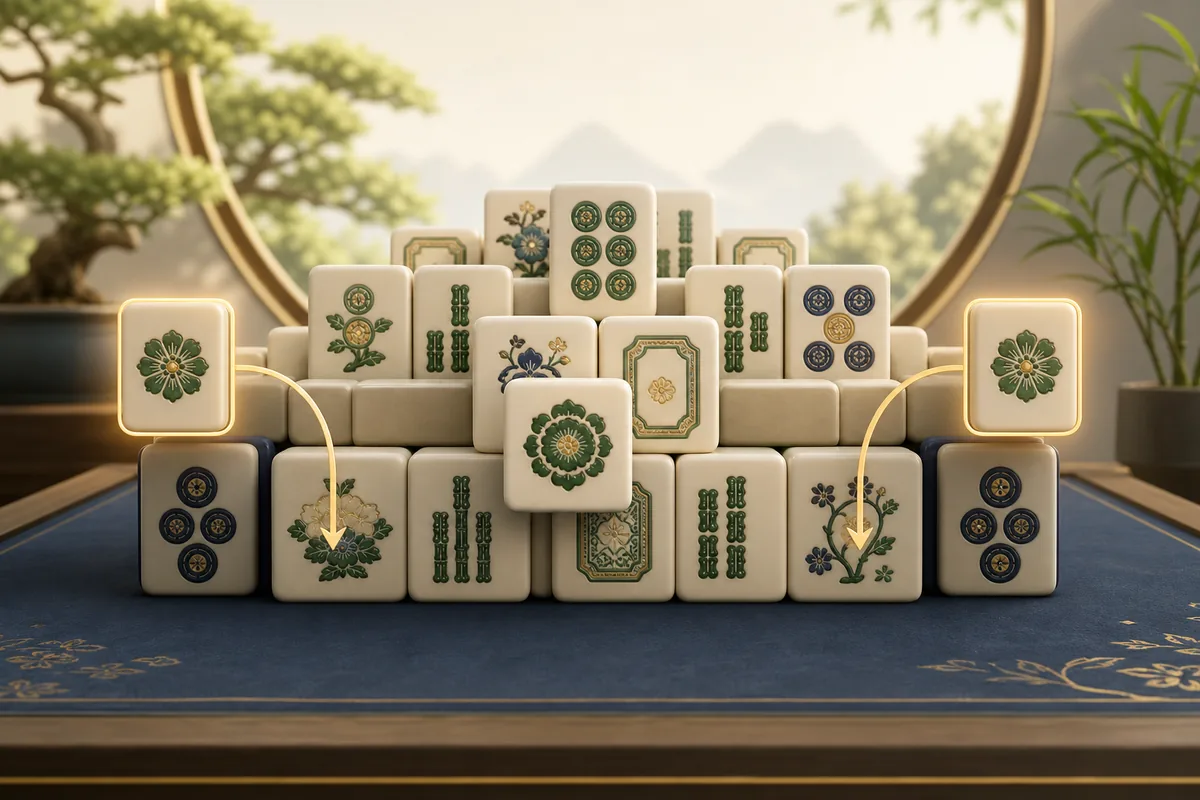
Step 1: identify selectable tiles
Scan the top layer and the outer ends of rows. A piece with an exposed picture is not necessarily free; another tile may overlap it from the layer above. Likewise, a tile with a clear top remains locked if neighbours touch both long sides. Corners and protruding pieces are often available, but apply the full test every time.
Most digital boards visually reject a blocked tile or shade it differently. Use that feedback to learn the geometry rather than clicking every face. Once you can predict which tiles are selectable, the position becomes easier to read several moves ahead.
Step 2: form a legal pair
Ordinary suit tiles, Winds, and Dragons need identical faces. Flower tiles are the exception: any Flower can normally match any other Flower. Seasons behave the same way within their own group, but a Flower cannot pair with a Season. Select the first free tile, then a matching free partner to remove both.
If four copies of a face are exposed, do not automatically take the closest pair. Compare what each option uncovers. A tile resting on a central stack or sealing a long row has greater structural value than an isolated edge tile that releases nothing.
Step 3: keep the board open
Alternate between reducing height and shortening wide rows. Watch for identical tiles sitting on top of one another, because the upper copy may need to be paired elsewhere before the lower one becomes accessible. Avoid removing two convenient copies if that leaves another pair mutually blocked.
You win when every tile is removed. A board is stuck when tiles remain but no legal matching pair is available. Some games then offer undo or shuffle; stricter versions require a restart. The useful lesson is to trace the blockage back to an earlier pair choice and try the alternative branch.
For a first practice board, say the reason for each move aloud: “this pair lowers the centre” or “this pair opens the left row.” Naming the effect slows impulsive choices and makes the three-step process easier to remember on the next layout.
Verify a move with three quick questions
Before removing a pair, ask: are both tiles uncovered, does each have a free left or right side, and do the faces form a legal match? Then add one strategic check: what becomes accessible next? This sequence catches the most common beginner error—confusing a visible tile with a selectable one—without slowing the game once the habit becomes automatic.
If a move exposes two tiles, inspect both before continuing. The first new match you notice is not necessarily the best one. One exposed tile may open a central layer while the other only clears an outside edge, so the board should be rescanned after every structural change.
Applied analysis
A ten-move practice drill
On a new board, play only ten pairs and pause. For every move, name the structural result before clicking: “opens the right edge,” “lowers the centre,” or “preserves two partners.” After the tenth pair, count the distinct legal matches that remain. Restart and try a different opening, then compare the count and the regions you exposed. The exercise removes the pressure to finish and makes cause and effect visible. A line with several independent matches is usually healthier than one narrow sequence of forced moves.
Quick answers
Questions players ask
Can I select a tile with only its short edge open?
No. Standard solitaire rules look at the left and right long sides. At least one must be clear, and the top must also be uncovered.
What should I do when several pairs are available?
Prefer the pair that uncovers a stack, opens a long row, or preserves more duplicate faces for later.